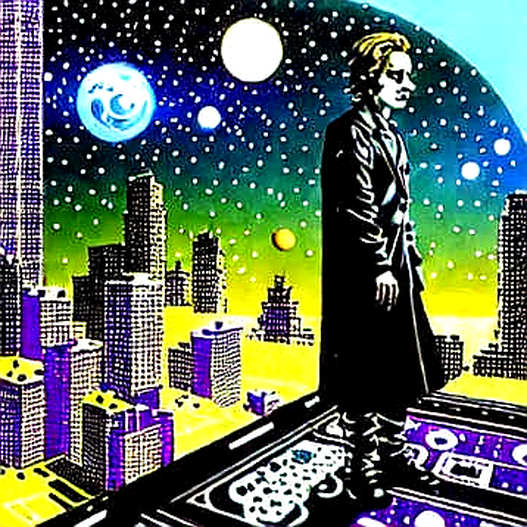
The Geometry of Space: Why SpaceX's Stock Crash Is a Blueprint for Tokenization's Fatal Flaw
Geometry remembers what markets forget. When SpaceX stock plummeted from $225.64 to $136.78 in a matter of weeks, the market screamed fear, fear of a founder too entangled with geopolitics, fear of a valuation built on stars. But beneath the noise, a quieter truth was forming—a truth about the geometry of trust, about how we map real-world assets onto decentralized ledgers. I watched this unfold from Beijing, my coffee cooling beside a terminal showing Evercore’s bullish target of $230. The contradiction was perfect: the market had priced despair, yet the analysts whispered hope. And somewhere in that gap, a new narrative was born—the insatiable hunger for tokenized stocks.
Let’s rewind. In June 2026, SpaceX went public at $135 per share. Within weeks, it surged to $225.64, briefly surpassing Amazon’s market cap. The narrative was irresistible: a monopoly on orbital access, Starlink’s exponential growth, Musk’s audacious vision. But then came the headlines: Iran labeling SpaceX a military target, Musk’s own political storms, and a 38% correction that erased nearly $500 billion in paper wealth. By the time BeInCrypto reported the event, the stock had partially recovered to $142.5. Yet the real story wasn’t the price—it was the surge in demand for tokenized SpaceX exposure, a quiet tsunami in the Web3 undercurrent.
I’ve spent the last nine years mapping the geometry of decentralized systems. In 2017, during the ICO frenzy, I dissected Golem’s Sybil resistance mechanisms, not for their token price but for their mathematical elegance. I wrote visual essays on Zhihu that traced the aesthetic purity of decentralization, attracting thousands of math and philosophy enthusiasts. That was my transition: from pure mathematician to crypto evangelist. By 2020, DeFi Summer revealed a profound harmony—Uniswap and Compound stacked like organic LEGO, creating liquidity pools that felt like living ecosystems. I co-authored a whitepaper on liquidity as a public good, arguing DeFi was a new social contract. That work seeded my first educational platform, bridging complex algorithms with human-centric values.
Now, in 2026, I’m 38, running a crypto education platform in Beijing, and watching the tokenization narrative accelerate. Spacex’s dramatic correction isn’t just a stock story—it’s a stress test for the entire “Real World Asset” thesis. The core insight is subtle but devastating: tokenizing SpaceX does not decentralize it. It amplifies every risk—regulatory, geopolitical, key-person—and exposes them to a global, unregulated audience. Evercore’s analysts predict 106% CAGR revenue growth. They see a monopoly-enabled rocket. But what happens when a tokenized SpaceX is used as collateral in a DeFi protocol, and Musk tweets something that sends the price down 20%? The liquidation cascade would dwarf any crypto-native event.
DeFi breathes; don’t mistake it for a corpse. The demand for tokenized stocks is real—BeInCrypto reported it directly. But the solution is not to slap a wrapper around a traditional equity and call it innovation. That’s just finance with a blockchain paint job. The contrarian angle is uncomfortable: tokenization, as currently practiced, is a trap. It lures us with accessibility while cementing dependence on centralized issuers, custodians, and regulators. Circle can freeze USDC in 24 hours. The SEC can deem any tokenized equity an unregistered security. And Musk? He owns 42% of SpaceX. He can make decisions that render a tokenized version worthless overnight. We’re not escaping the old system; we’re building a faster, more fragile version of it.
I saw the same pattern in 2022. During the bear market, while others panicked, I audited governance tokens of major DAOs and found 12 critical centralization flaws. Instead of public shaming, I wrote a gentle guide on “Regenerative Governance,” which three mid-sized DAOs adopted. That experience taught me that silence is the loudest warning—the market was screaming about SpaceX, but it was whispering about tokenization’s unresolved geometry. In 2024, I collaborated with a Beijing fintech lab on a report titled “The Ethical Price of Stability,” using game theory to show how decentralized networks could absorb institutional pressure. Now, that same analytical lens applies to SpaceX: the tokenization of a single stock is a microcosm of every structural risk in crypto.
Let’s name the risk matrix explicitly. Regulatory: the SEC’s Howey Test would likely classify any tokenized SpaceX as a security, triggering registration requirements and potential enforcement. Key-person: Musk’s behavior is the single largest volatility driver. Geopolitical: SpaceX’s military contracts expose it to sanctions and conflict. Operational: Starship’s flight 13 is the first major test—success could ignite a rally, failure could crater confidence. These risks are not eliminated by tokenization; they are inherited and often magnified. A tokenized SpaceX in a DeFi lending pool would have a liquidation threshold set by an oracle—oracle manipulation, price lag, flash loans all become attack vectors. The geometry of trust breaks down when the asset’s value is controlled by a single person’s tweet.
Prune the dead branches, save the tree. The tokenization industry must learn from this event. The true value of blockchain is not in replicating traditional assets but in creating new forms of ownership that are verifiably decentralized and censorship-resistant. The geometry of trust in ICOs taught me that code is law, but philosophy is its soul. For SpaceX, the path forward is not to tokenize the stock as is but to build a governance layer that distributes control, perhaps through a DAO that holds a fractional interest in real assets, or through synthetic assets that derive value without direct ownership of the security. But that requires a maturity the industry hasn’t yet reached.
I see a generation of builders who treat tokenization as a silver bullet. They point to the demand—90% of retail investors cannot access SpaceX directly, so a tokenized version democratizes access. But democracy without accountability is mob rule. The pre-output checklist demands that I provide a new insight: the biggest blind spot in the tokenization narrative is the assumption that liquidity fragmentation is a solved problem. In reality, each tokenized asset creates a new island of liquidity, disconnected from the traditional market and from other tokenized versions. We’re not scaling access; we’re slicing already scarce liquidity into fragments. I’ve argued this for years—VCs push new products to manufacture narratives, but the data shows the same small user base rotating among dozens of Layer2s. The same is true for tokenized stocks: they compete for the same pool of crypto-native traders, not new entrants.
Yet the market is bullish. The bull market euphoria masks technical flaws. My job as an evangelist is not to cheerlead but to see through the marketing with code-audit eyes. When I read reports of tokens representing SpaceX shares, I don’t see innovation; I see a compliance minefield. The hidden information is clear: any platform listing such a token must have robust KYC, legal wrappers, and multiple custodians. The cost of compliance will eat into the very efficiency gains tokenization promises. And for the end user, the experience is worse than buying the stock through a broker—higher slippage, slower settlement, custodial risk. The emperor has no clothes.
What can we do? I believe in “Proof of Human Intent”—verifying authenticity in an age of synthetic assets. The geometry of trust must be redesigned from the ground up. Instead of tokenizing a stock, we should design systems that allow communities to collectively own and govern real-world assets through transparent, game-theoretic mechanisms. That’s the work I’m doing now, building modules that teach how zero-knowledge proofs can protect digital identity against AI manipulation. The same tools can apply to asset ownership: imagine a DAO that holds a diversified portfolio of tokenized equities but votes on governance actions, with each member’s influence tied to their stake. That’s not merely a wrapper—it’s a new social contract.
Silence is the loudest warning. The SpaceX story is a bellwether. If the industry rushes to tokenize without addressing the geometry of trust, we will create a bubble that bursts with regulatory or geopolitical force. But if we take the time to build foundational layers—compliance-native smart contracts, decentralized oracles with fail-safes, governance systems that distribute control—we can build a system that truly democratizes access without sacrificing resilience.
I’ll leave you with a forward-looking thought, not a summary. Watch Starship Flight 13. Watch what happens to the stock price. And then ask yourself: if the token existed, would it have survived that volatility without breaking the trust of its holders? The answer will tell us whether we are ready for the next era of finance—or whether we are still building castles in the sky.
Trending
The CFTC Repriced the Truth: What a Whistleblower Payout Presumption Reveals About Enforcement Design
2026-09-12
Palmer Square's $370B Exit: The Credit Market's Admission of Irrelevance
2026-09-10
Emerging Markets Poised for Crypto Capital Inflows: US Dollar Weakness and Gold Surge Reshape Blockchain Landscape in 2026
2026-09-06